Hi,
I struggled a little to get my head around it too. 
I'm letting y=f(x) some of the time because it is easier for me to work with.
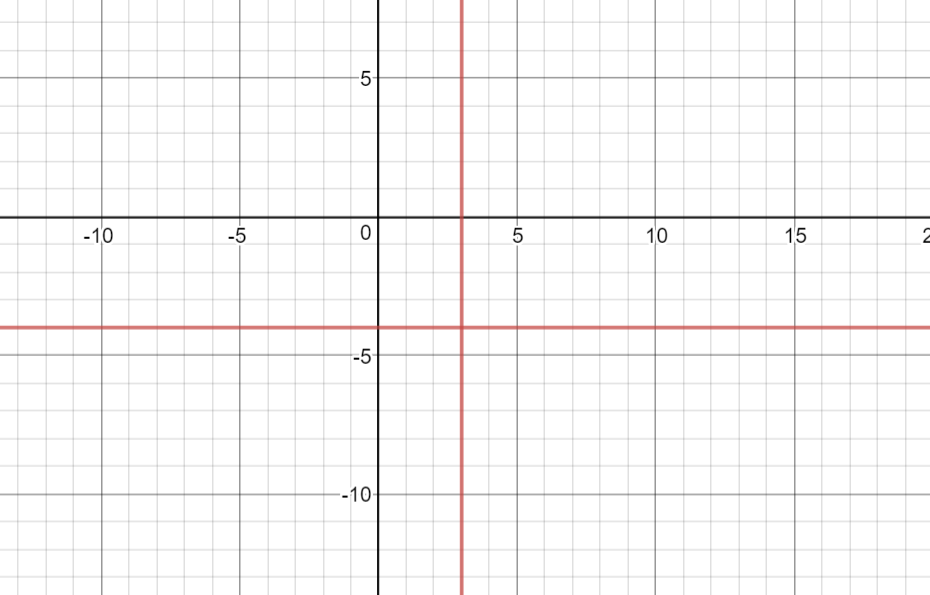
there is a vertical asymptote at x=3 this means that y tends to =+ or - infinty when x=3
This will happen if the denominator tends to 0 as x tends to 3
hence c=-3
There is a horizontal asymptote at y=-4.
This means that as y tends to -4, x tends to =+ or - infinty
So
\(\displaystyle \lim_{x\rightarrow \infty}\; f(x)=-4\qquad or \qquad \displaystyle \lim_{x\rightarrow -\infty}\; f(x)=-4\\ a=-4\qquad or \qquad a=-4\\ so\;\;a=-4 \)
so we have
\(f(x) = \frac{-4x+b}{x-3}\)
Now sub in ( 1,0) to get the value of b
you will get b=4
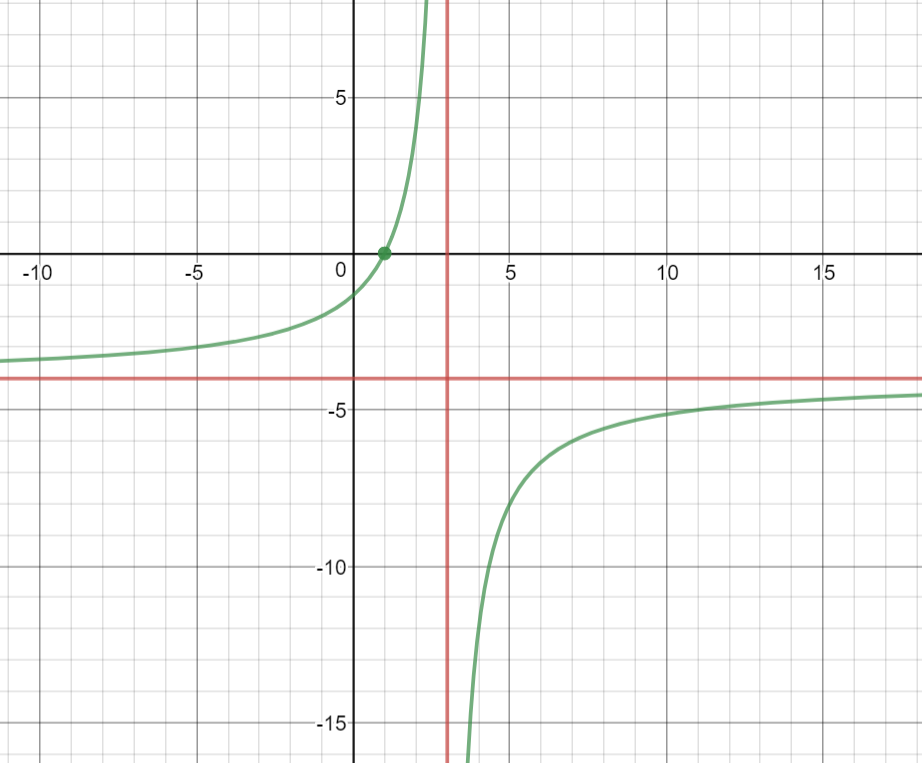
\(f(x) = \frac{-4x+4}{x-3}\)
If you think about the asymptotes on a graph it might help. It did help me.
And here is the actual graph


 +118735